

An industrial equipment manufacturer has a requirement: its outdoor robots need to operate stably in extreme environments such as heavy rain and salt spray. Existing wiring harnesses experience signal interruptions due to water ingress after long-term use, resulting in a failure rate as high as 15% per month. The customer requires a new product that meets IP68 protection standards (no leakage after immersion in 1 meter of water for 72 hours), and is also adaptable to a wide temperature range of -40℃ to +105℃, resistant to UV radiation, and resistant to acid and alkali corrosion.
Technology Development Process
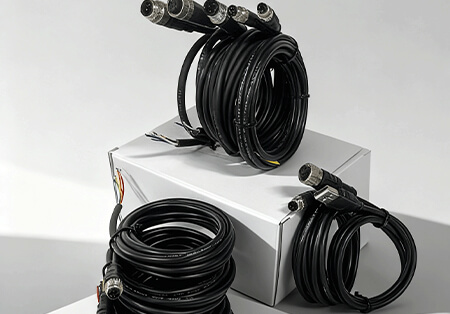
1. Material System Innovation
Conductor Layer: Uses pure copper wire (purity ≥99.99%) to reduce water adsorption caused by capillary action and improve conductivity (reducing resistance by 8% compared to pure copper wire).
Insulation Layer: The inner layer uses PTFE material with a low dielectric constant (≤2.1), and the outer layer is composite with weather-resistant TPE. Seamless bonding is achieved through a co-extrusion process, improving hydrolysis resistance by 3 times.
Sheath Layer: HDPE material containing carbon black masterbatch (carbon black content ≥2.5%) is used. Its UV aging resistance has passed the QUV test (no cracking after 1000 hours). Nano-level corrosion inhibitors (such as nano zinc oxide) are added, extending salt spray resistance from 500 hours to 2000 hours.
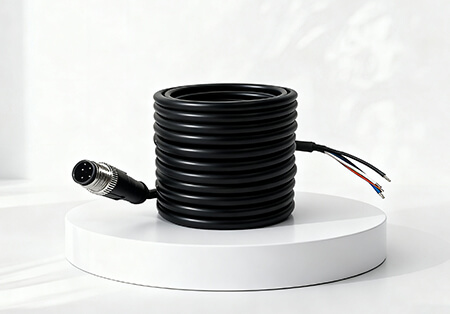
3. Breakthrough in Sealing Technology
Insulation Molding: High-precision molds (tolerance ≤ ±0.01mm) are used to injection mold the connector shell, cable sheath, and fluororubber sealing ring in one piece, eliminating interface gaps. The injection molding material is PA66+GF (glass fiber content 30%), with a tensile strength of 120MPa.
Threaded Locking Structure: The connector uses threads (1.5mm pitch) with nickel-plated nuts. The tightening torque is controlled at 8-10 N·m to ensure long-term underwater sealing.
4. Testing and Verification System
Environmental Simulation Testing:
Waterproof Test: After immersion in 1 meter of water for 72 hours, insulation resistance ≥1000MΩ (standard requirement ≥100MΩ).
Salt Spray Test: After spraying with 5% NaCl solution for 96 hours, the sheath surface shows no corrosion, and conductor resistance change ≤1%.
High and Low Temperature Cycling: After 50 cycles at -40℃ to +105℃, cable outer diameter change ≤±0.5%, signal attenuation ≤0.3dB.
Mechanical Performance Testing:
Bending Life: Under conditions of 10 times the cable outer diameter, 10 million bending cycles without core wire breakage.
Tensile Strength: Cable withstands tensile force ≥2000N (cross-sectional area 4mm²), connector mating life ≥500 cycles.
Electromagnetic Compatibility Test: In the 10MHz-1GHz frequency band, radiated interference ≤30dBμV/m, immunity ≥20V/m.
Customer Value Realization
Reliability Improvement: New product failure rate reduced from 15%/month to 0.5%/month, maintenance costs decreased by 80%.
Expanded Scenario Adaptability: Successfully applied to extreme scenarios such as coastal wind power (salt spray environment), tropical rainforest (high humidity), and mining (dust + vibration).
Significant Economic Benefits: Although the unit price is 30% higher than traditional wire harnesses, the total life cycle cost (including maintenance and downtime losses) is reduced by 50%, and the customer repurchase rate reaches 90%.
Industry Promotion and Technology Extension
Standardization Output: The product has passed UL, CE, and IP68 certifications and participated in the formulation of the industry standard “Technical Specification for Waterproof Wire Harnesses for Industrial Equipment”.
Technology Transfer: Core technologies such as nano-coating and water-blocking structures are applied to high-voltage wire harnesses for new energy vehicles (supporting 800V platforms) and medical equipment connection cables (resistant to bio-corrosion).
Green Manufacturing: Uses halogen-free flame-retardant materials, waste cable recycling rate reaches 95%, and complies with EU RoHS and REACH directives. In summary, this case study successfully developed a high-performance waterproof wire harness that meets IP68 protection standards through material innovation, structural optimization, process breakthroughs, and rigorous testing, validating the R&D path of “demand-driven – technology implementation – value transformation.” Its core lessons learned are: 1. Systematic innovation from material molecular structure to overall product design; 2. A comprehensive testing system simulating real-world scenarios; 3. A rapid iteration mechanism for joint validation with customers. This model provides a replicable solution for the wire industry to address the challenges of complex environments.
111111111111111111111111111
 Address: A203, Building 3, Xinsheng Community, Longgang Subdistrict, Longgang District, Shenzhen, Guangdong Province


